 Discovering who "Guy de Vere" was will confirm or deny the suspicion that "Lenore" might be Poe's pseudonym for the wife or the mistress of another man. The writer "come of a race noted for vigor of fancy and ardor of passion" wrote at least seven love poems to ladies whose names were purposely camouflaged as follows, (i) "To ---" (ii) "To F---" (iii) "To F---S S. O---D" (iv) "To Helen" (v) "To Helen" (vi) "To M---" and (vii) "To M. L. S---". Various scholars have identified "F---S S. O---D" as Frances Sargent Osgood, a married poetess of some renown, the addressee of (iv) "To Helen" as Mrs. Helen Stannard, the addressee of (v) "To Helen" as Mrs. Sarah Helen Whitman, and "M. L. S---" as Mrs. Marie Louise Shew, Virginia's nurse. The suspicion is warranted therefore.
A second misgiving, linked to Poe's childhood, was laid to rest. The child Poe moved with his foster family to Great Britain in 1815 and did not return to the United States until 1820. Overseas the Allan family stayed in London but unaccountably sent 6-year-old Poe away to grammar school in Irvine, a village near Glasgow on the south foreshore of the Firth of Clyde. The 1816-17 school year saw the 7-year-old child lodged at a boarding school in the affluent Chelsea district of London. From the autumn of 1817 onward he studied at Reverend John Bransby's Manor House School in Stoke Newington, another borough of London. These frequent changes of learning institution together with the school-year-long estrangement from his foster family in the very country that a mere forty years earlier had attempted to vanquish the American rebels—a fact that his classmates were probably more than willing to remind him of privately and publicly—must have filled the adopted child with a profound sense of insecurity and alienation and must have made it difficult for him to work and play with the native pupils.
AloneFrom childhood's hour I have not beenAs others were; I have not seen As others saw; I could not bring My passions from a common spring. From the same source I have not taken My sorrow; I could not awaken My heart to joy at the same tone; And all I loved, I loved alone. Then—in my childhood, in the dawn Of a most stormy life—was drawn From every depth of good and ill The mystery which binds me still: From the torrent, or the fountain, From the red cliff of the mountain,1 From the sun that round me rolled In its autumn tint of gold, From the lightning in the sky As it passed me flying by, From the thunder and the storm And the cloud that took the form (When the rest of Heaven was blue) Of a demon in my view. Edgar Allan Poe, 1829. |
In the year 1820 the child Poe sailed with his foster family back to Richmond, VA.
Since the surname "De Vere" calls up the prestigious ancestry of the Earl of Oxford, the possibility arises that, partly as a reminiscence of his years spent in Britain, Poe might have referenced an actual "Guy de Vere" from that distinguished lineage. A perusal of the De Vere genealogy yielded the following list of male forenames, alphabetically ordered,
|
In the absence of any more hypotheses it is time to inspect the poem Lenore itself for clues about "Guy de Vere." The first impression gleaned is that the personage quoted on stanzas 2 and 4 is an educated gentleman of social rank above the "wretches" who can hardly conceal their glee at Lenore's passing (2.3-5).
LenoreAh, broken is the golden bowl! the spirit flown forever!Let the bell toll!—a saintly soul floats on the Stygian river; And, Guy de Vere, hast thou no tear?—weep now or nevermore! See! On yon drear and rigid bier low lies thy love, Lenore! Come! Let the burial rite be read—the funeral song be sung!— An anthem for the queenliest dead that ever died so young— A dirge for her the doubly dead in that she died so young.
"Wretches! Ye loved her for her wealth and hated her for her pride,
Peccavimus; but rave not thus! and let a Sabbath song
"Avaunt! Tonight my heart is light. No dirge will I upraise, Edgar Allan Poe, 1843. |
Ah, broken is the golden bowl! the spirit flown forever! (1.1): Pointer to Ecclesiastes 12:6-7.
And, Guy de Vere, hast thou no tear?—weep now or nevermore! (1.3): The Shakespearean-sounding pronoun "thou" and the archaic present tense 2nd singular "hast" point to a British gentleman. This manner of speech continues on 1.4 ("yon" and "thy") and 3.4 ("thee" and "thy").
Wretches! ye loved her for her wealth and hated her for her pride (2.1): Lenore is linked to wealth and pride and so must Guy de Vere be: the British gentleman is a member of the nobility.
Peccavimus; but rave not thus! and let a Sabbath song go up to God so solemnly the dead may feel no wrong (3.1-2): Peccavimus is Latin for "We sinned." The British nobleman thus addressed is a religious Roman Catholic.
Avaunt! Tonight my heart is light. No dirge will I upraise, but waft the angel on her flight with a Paean of old days! (4.1-2): Guy de Vere finally complies with the request to compose a poetic song for Lenore (1.5-7, 3:1-2) but he will upraise a paean instead of a dirge. The Roman-Catholic British nobleman must be a composer of religious anthems (1.6) Sabbath songs (3.1) dirges and songs of praise (paeans) of some renown.
Armed with these clues, and being a priori satisfied with a 75% match, a historical search was made for a contemporary of Poe who would fit the depiction of "Guy de Vere." The search yielded an unexpected success.
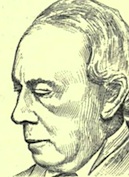 Sir Aubrey de Vere né Aubrey Hunt (b. 1788, d. 1846) was the only son of Sir Vere Hunt and Hon. Eleanor Pery.
The father Sir Vere Hunt was the second son of the 16th Earl of Oxford and owned the title of 1st Baronet of Curragh in county Limerick, Ireland.2
The mother Eleanor Pery was the sister of the Earl of Limerick and the daughter of Lord Glentworth, Church of England bishop of Limerick.
The child Aubrey Hunt was first educated at home by private tuition. His profound love of Nature prompted him to write descriptive poetry from a very early age.
In his boyhood he was sent away to Ambleside in the Lake District of Cumbria, Northwest England, under the care of a private tutor, the Rev. John Dawes. He was captivated by the natural beauty of the area and returned to it for visits as an adult. One of his boyhood hobbies was the thorough study of ancient and modern military campaigns with the aid of maps and books.
Thereafter he was enrolled in the prestigious Harrow School of London where he and Lord Byron became childhood friends. After graduation he returned to Ireland and pursued higher education at Trinity College of Dublin.
In 1807 he married Mary Spring-Rice of Mount Trenchard, eldest daughter of Stephen Edward Rice and sister of Lord Monteagle.3
The young couple had five sons and three daughters. The firstborn son was Sir Vere Edmund de Vere (b. 1808, d. 1880) who succeeded to the title upon his father's death. The second son was William Edward de Vere (b. 1811, d. 1904). His younger brother Stephen Edward de Vere (b. 1812, d. 1904) was an outstanding poet and a convert to Roman Catholicism. Aubrey Thomas Hunt de Vere (b. 1814, d. 1902) was another outstanding poet, and he converted to Roman Catholicism in 1857. Major Francis Horatio de Vere (b. 1828, d. 1865) joined the Royal Military Engineers and was shot dead by a sapper during a parade at Brompton Barracks in Chatham, Kent, Southeast England.
Aubrey Hunt wrote the following sonnet about family life in 1816 and published it in 1823. It is evident from the poem that Mary Spring-Rice was expecting their second daughter (lines 1-2). The children who appear in these verses can be guessed at: Stephen Edward (v. 3) Vere Edmund (v. 4) their first daughter (v. 5) and William Edward (vs. 7-8). One boy is missing, he may have been baby Aubrey Thomas, perhaps sleeping indoors under a nurse's care.
The Family PictureWITH work in hand, perchance some fairy capTo deck the little stranger yet to come; One rosy boy struggling to mount her lap— The eldest studious, with a book or map— Her timid girl beside, with a faint bloom, Conning some tale—while, with no gentle tap, Yon chubby urchin beats his mimic drum, Nor heeds the doubtful frown her eyes assume. So sits the mother! with her fondest smile Regarding her sweet little-ones the while; And he, the happy man! to whom belong These treasures, feels their living charm beguile All mortal cares, and eyes the prattling throng With rapture-rising heart, and a thanksgiving tongue. (The Duke of Mercia. Sonnets, #8, p. 282) |
Aubrey Hunt served one term as High Sheriff of county Limerick in 1811.
He succeeded to his father's title in 1818, becoming 2nd Baronet.
He made a mild attempt to enter politics, and for a time was Sheriff of the County Limerick, but, on being defeated in an attempt to represent the county in Parliament, he desisted and devoted his life to travel and poetry, as well as to the care of his large estates at Curraghchase and at Glangoole, County Tipperary. He rebuilt the family house at the former place and made it one of the county's glories by employing John Flaxman, the celebrated sculptor, to work a frieze in the main hall.(http://www.limerickcity.ie/library/ [7 Dec 2016]. Limerick City Library)
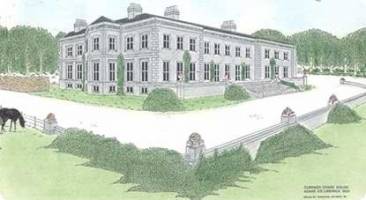
The estate initially known to Englishmen as "Currah" (modern spelling: Curragh, a Gaelic word meaning "bog") was a land grant by Cromwell in 1657 to one of his officers, Vere Hunt. The property is located twenty kilometers away from the city of Limerick. The 2nd Baronet rebuilt the original manor house built by Hunt, adorned the family residence "with the eye of a painter," and assembled a good collection of military, poetry and history books in the library; he is probably also responsible for the small family-pet cemetery near the mansion. He changed the name of the estate to "Currah Chase" in 1833 (modern spelling: Curraghchase).
The 2nd Baronet undertook a vast tree-planting project in Curraghchase and created the three hundred hectares of forest land that still stand today. The woods are a mixture of broadleaf and evergreen trees: sycamores mingle with hornbeam, Scots Pine, beech, ash, hazel and several kinds of oak trees.
Fire gutted Curraghchase House in 1941, leaving only the exterior walls standing. The Forestry Division of the Irish government purchased the property in 1957 and turned the land into a national forest and park with eight kilometers of marked trails. A protected species of bat nests in the burnt-out cellars today.
"A Poet's Home" which appeared in the Poems section of The Duke of Mercia (1823) expounds the baronet's vision of the ideal home, some of whose features doubtlessly applied to Curraghchase House: a cottage closed with trees of every flower and leaf, airy yet sheltered, roses and flowers climbing over the white walls, a patch of blooming, aromatic shrubs before the porch, a spacious library with a deep bow window sunlit through green leaves, "our bright-faced infant throng," faithful friends who gather round the household fire in the evening to recite poetry, dance or listen to music; and gathered round his door "a busy, cheerful, virtuous poor, homely in speech and pure from art, Truth and the Bible in their heart."
The 2nd Baronet changed his surname by royal licence to "Sir Aubrey de Vere" in 1833 to flaunt the family's ties to the House of the 1st Earl of Oxford. House De Vere's motto is Vero Nihil Verius (Nothing is truer than the truth). Its French epigram is Verité Vient (Comes Truth).
Sir Aubrey de Vere's early works were historical dramas: Julian the Apostate, a dramatic Poem (1822) and The Duke of Mercia, an historical Drama. The Lamentation of Ireland, and other Poems (1823). The author's name printed for both books is "Sir Aubrey de Vere Hunt."
| Supplement to Lenore: Answers To Some Questions On The Raven |